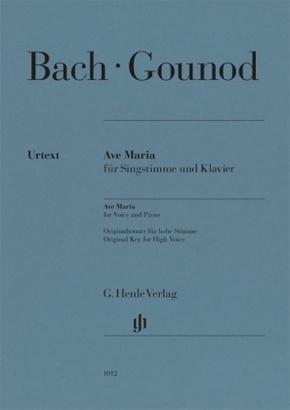
Charles Gounod - Ave Maria - Besetzung: Singstimme und Klavier
Reduzierte Artikel in dieser Kategorie

5,99 €
10,99 €
| Verlag | Henle |
| Auflage | 2022 |
| Seiten | 6 |
| Format | 21,0 x 0,2 x 30,0 cm |
| Gewicht | 62 g |
| Reihe | G. Henle Urtext-Ausgabe |
| ISBN-13 | 9790201810126 |
| Bestell-Nr | 96250439BA |
Gounod had no qualms about arranging well-known works by earlier masters after his own fashion. Thus in 1852 he added a melody with its own operatic climax to the famous arpeggios of the C-major Prelude BWV 846 from Bach's Well-Tempered Clavier. He first published instrumental versions of it under the title "Méditation", then tried fitting various texts to the melody until in 1859 he arrived at the definitive vocal version using the text of the Ave Maria. Already by the 1890s it was claimed that "[we] have heard this sweet melody innumerable times from the best lady singers", and its popularity has continued to the present day. Reason enough, then, for Henle Verlag to publish an Urtext edition of this worldwide hit, based on the sources and with appropriate critical commentary.
Gounod n'éprouvait aucune honte à arranger à sa manière des oeuvres célèbres de maîtres du passé. C'est ainsi qu'en 1852, il ajouta aux célèbres accords brisés du Prélude en Ut majeur BWV 846 du Clavier bien tempéré de Bach une mélodie bâtie selon une progression opératique. Les versions instrumentales publiées d'abord sous le titre de Méditation furent l'une après l'autre pourvues de différents textes mis à l'essai, jusqu'à ce qu'en résulte, en 1859, la version vocale définitive avec le texte de l'Ave Maria. Dès les années 1890, on disait «avoir entendu d'innombrables fois cette douce mélodie rendue par les meilleures chanteuses». Cette popularité persiste encore de nos jours - une bonne raison de présenter ce succès mondial également sur la base éditoriale des sources établies et commentées dans la collection Urtext des Éditions Henle.
Gounod kannte keine Scheu, bekannte Werke früherer Meister auf seine ganz eigene Art einzurichten. So ergänzte er 1852 zu den berühmten Akkordbrechungen des C-dur-Präludiums BWV 846 aus Bachs Wohltemperiertem Klavier eine auf opernhafte Steigerung angelegte Melodie. Die zunächst als Méditation veröffentlichten Instrumentalfassungen wurden nacheinander mit unterschiedlichen Textierungen erprobt, bis sich 1859 mit "Ave Maria" die definitive Vokalfassung ergab. Bereits in den 1890er-Jahren hieß es, man habe "diese süße Melodie von den besten Sängerinnen unzählige Male gehört". Diese Popularität hält bis heute an - Grund genug, diesen Welterfolg auch auf Basis der Quellen ediert und kommentiert im Urtext des Henle Verlags vorzulegen.
Inhaltsverzeichnis:
Ave Maria (J. S. Bach)Ave Maria (J. S. Bach)
