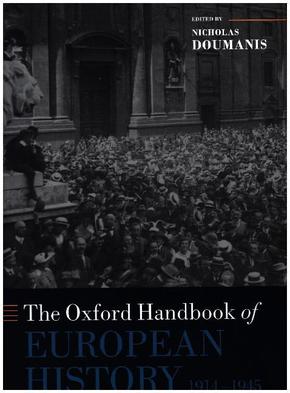
The Oxford Handbook of European History, 1914-1945
Reduzierte Artikel in dieser Kategorie

10,99 €
10,99 €
14,99 €
10,99 €
10,99 €
7,99 €
7,99 €
| Verlag | Oxford University Press |
| Auflage | 2016 |
| Seiten | 668 |
| Format | 17,9 x 25,1 x 4,1 cm |
| Print PDF | |
| Gewicht | 1295 g |
| Artikeltyp | Englisches Buch |
| Reihe | Oxford Handbooks |
| ISBN-10 | 0199695660 |
| EAN | 9780199695669 |
| Bestell-Nr | 19969566EA |
The period spanning the two World Wars was unquestionably the most catastrophic in Europe's history. Despite such undeniably progressive developments as the radical expansion of women's suffrage and rising health standards, the era was dominated by political violence and chronic instability. Its symbols were Verdun, Guernica, and Auschwitz. By the end of this dark period, tens of millions of Europeans had been killed and more still had been displaced and permanently traumatized. If the nineteenth century gave Europeans cause to regard the future with a sense of optimism, the early twentieth century had them anticipating the destruction of civilization.
The fact that so many revolutions, regime changes, dictatorships, mass killings, and civil wars took place within such a compressed time frame suggests that Europe experienced a general crisis. Indeed in the early 1940s both Charles de Gaulle and Winston Churchill referred to a 'thirty years war'. Why did so many crises rage across the continent from 1914 until the end of the Second World War? Why did the winds of destruction affect some regions more than others?
The Oxford Handbook of European History, 1914-1945 reconsiders the most significant features of this calamitous age from a transnational perspective. It demonstrates the degree to which national experiences were intertwined with those of other nations, and how each crisis was implicated in wider regional, continental, and global developments. Readers will find innovative and stimulating chapters on various political, social, and economic subjects by some of the leading scholars working on modern European history today.
Inhaltsverzeichnis:
- Introduction: Europe's Age of Catastrophe in Context
- Part I: Europe And The First World War
- 1: Alan Sked: Belle Époque: Europe before 1914
- 2: Stefan Goebel: Societies at War, 1914-1918
- 3: Tammy M. Proctor: Total War: Family, Community, and Identity during the First World War
- 4: David Priestland: The Left and the Revolutions
- 5: Matthias Blum and Jari Eloranta: The Economics of Total War and Reconstruction, 1914-1922
- Part II: Recasting Europe, C. 1917-1924
- 6: Alan Sharp: The New Diplomacy and the New Europe, 1916-1922
- 7: Ryan Gingeras: Nation-states, Minorities, and Refugees, 1914-1923
- 8: Conan Fischer: Remaking Europe after the First World War
- Part III: Interwar Europe And The Wider World
- 9: Roger Middleton: The Great Depression in Europe
- 10: Anthony Adamthwaite: 'A Low Dishonest Decade'? War and Peace in the 1930s
- 11: Matthew G. Stanard: Interwar Crises and Europe's Unfinished Empires
- Part IV: Politics, Society, And Ideology Between The Wars
- 12: Laird Boswell: Rural Society in Crisis
- 13: Andrea Orzoff: Interwar Democracy and the League of Nations
- 14: Pamela Radcliff: The Political 'Left' in the Interwar Period, 1924-1939
- 15: Aristotle Kallis: Fascism and the Right in Interwar Europe
- 16: Julia Moses: Social Policy, Welfare, and Social Identities, 1900-1950
- 17: Paul M. Hagenloh: Discipline, Terror, and the State
- Part V: Themes
- 18: Roger D. Markwick and Nicholas Doumanis: The Nationalization of the Masses
- 19: Mary Vincent: Political Violence and Mass Society: A European Civil War?
- 20: Dagmar Herzog: European Sexualities in the Age of Total War
- 21: David W. Ellwood: 'America' and Europe, 1914-1945
- 22: Marco Duranti: European Integration, Human Rights and Romantic Internationalism
- Part VI: Europe And The Second World War
- 23: Jeremy Land and Jari Eloranta: Wartime Economies, 1939-1945
- 24: Shelley Baranowski: Axis Imperialism in the Second World War
- 25: Christoph Mick: Everyday Life in Wartime Europe
- 26: Mark Roseman: The Holocaust in European History
- 27: Aviel Roshwald: Europe's Civil Wars, 1941-1949
- Part VII: Recasting Europe, Again
- 28: Alexander V. Prusin: Nation Building and Moving People
- 29: Martin Thomas: Europe, the War, and the Colonial World
- 30: Gareth Pritchard: Power Relations during the Transition from Nazi to post-Nazi rule
- 31: Ben Mercer: The Memory of Europe's Age of Catastrophe, 1914-2014
